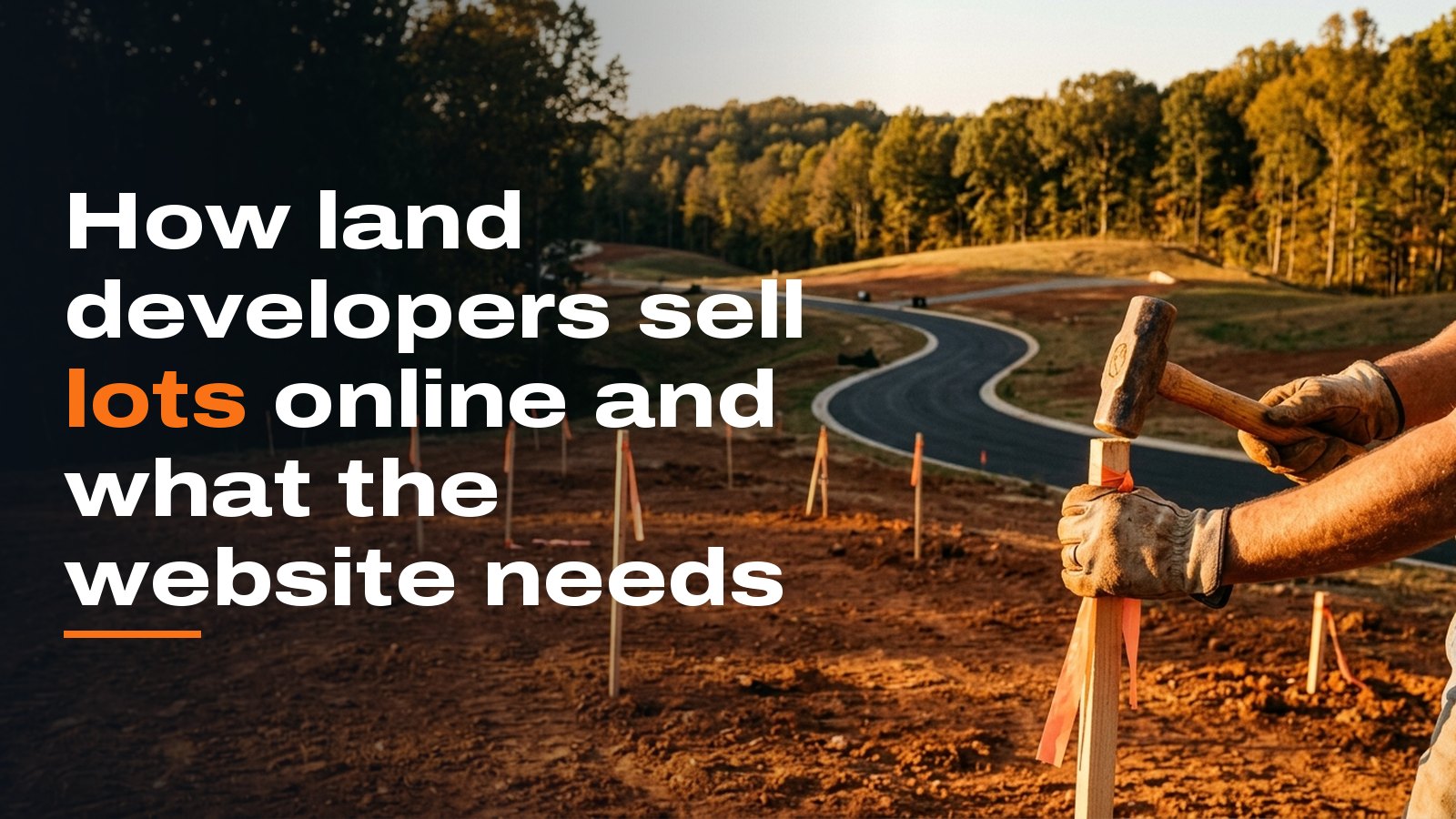
Online, you sell lots the same way you sell them in the field: by answering the buyer's first questions before they have to ask. Which lots are left, what do they cost, how big are they, what can I build, and can I go see it. A website that answers those on one screen turns traffic into lot walks. The contract still gets signed with a person, usually after someone has stood on the dirt.
What does the lot map need to show?
The lot map is the whole site. Everything else supports it. I mean a clickable site plan where every lot is colored by status and opens a detail panel, not a static PDF of the plat.
- Lot number and phase
- Status: available, reserved, under contract, sold
- Price, or a price range if you have a reason not to publish exact numbers
- Acreage and dimensions, including frontage
- Premium features: walkout potential, wooded, cul de sac, backs to open space
- Utilities: sewer or septic, public water, gas, electric
- Building restrictions: minimum square footage, setbacks, approved builders
- Photos taken on that lot
Photos matter more than anything else on that list. A buyer looking at a raw lot on a phone can't picture it from a plat. A drone shot with the lot lines drawn in, plus one ground photo from the street, does more than a paragraph of copy.
A lot map that shows a sold lot as available costs you more trust than having no map at all.
Who keeps the lot map accurate?
This is where most developer sites fail. The map launches correct, a few lots go under contract, nobody updates it, and three months later a buyer drives out to see a lot that sold in the spring. That buyer doesn't call back.
Name one person who owns the map, usually whoever handles contracts, and make changing a lot's status a two minute job in the admin. If every change requires an email to an agency, the map will go stale. On larger communities we connect the map to whatever system tracks contracts, so status updates without anyone touching the website.
The map is also what drives the cost. In my experience, sites with lot maps, inventory and multiple communities typically run $30,000 or more to build, plus $150 to $500 a month for hosting and maintenance. A single community with a simpler map can come in lower. That is a typical range, not a quote, and scope sets the number.
Should buyers be able to reserve a lot online?
I would not take deposits through the site unless your team can respond the same day. A lot is a big decision. Buyers want to walk it, ask about builders, and read the restrictions before money changes hands.
What works better is a "hold this lot" or "schedule a lot walk" button on every lot that alerts a salesperson immediately. It catches the buyer at peak interest without pretending this is an ecommerce checkout. Speed is the whole game here. A lot walk request answered the next afternoon is a lead you probably lost to the community down the road.
How is selling to builders different?
If you sell lots to builders, they need their own page, not the retail map. Builders want phase timing, lot counts by width, finished lot delivery dates, pricing per lot or per front foot, architectural standards, and a name to call. Put that on a builder program page with the plat and covenants available to download.
Keep it out of the main navigation if homesite buyers are your priority, but link it from the footer. An acquisition manager comparing several communities in a week will skip the one that hides the basics behind a form.
Builders and homesite buyers want different facts. Give them different pages.
How do buyers find the lots in the first place?
Most lot buyers search the community name, the town, or "lots for sale near" a town. Build a page for each community, and for each phase that sells separately, with the town in the page title and the first paragraph. In Middle Tennessee we see buyers search by town and school zone far more than by developer name, so put both on the page in plain text.
That plain text also decides whether AI search can recommend you. When someone asks ChatGPT or Perplexity for wooded lots near a town, it can only name your community if the acreage, location, price range and builder rules are written on the page. Details locked inside a map image or a PDF don't count.
Build the site around a lot map that is always right, give builders their own page, and answer lot walk requests fast. That covers most of what selling lots online takes.